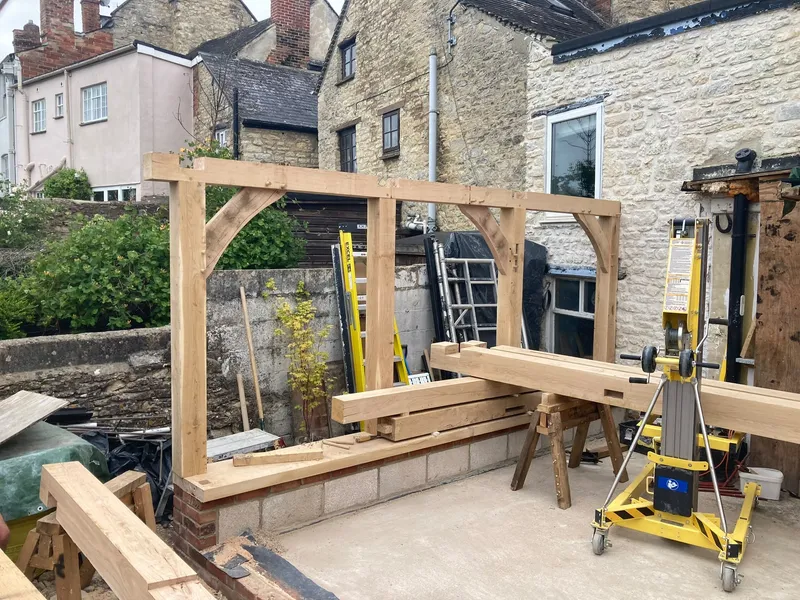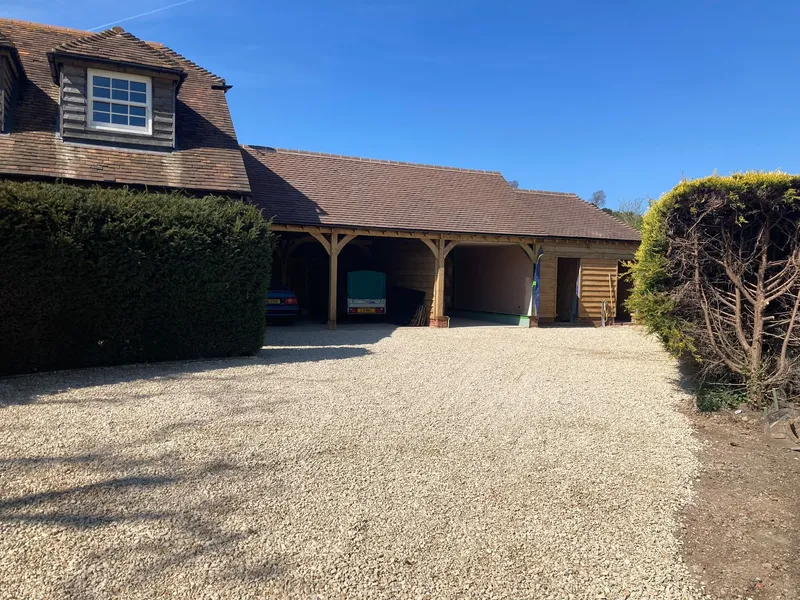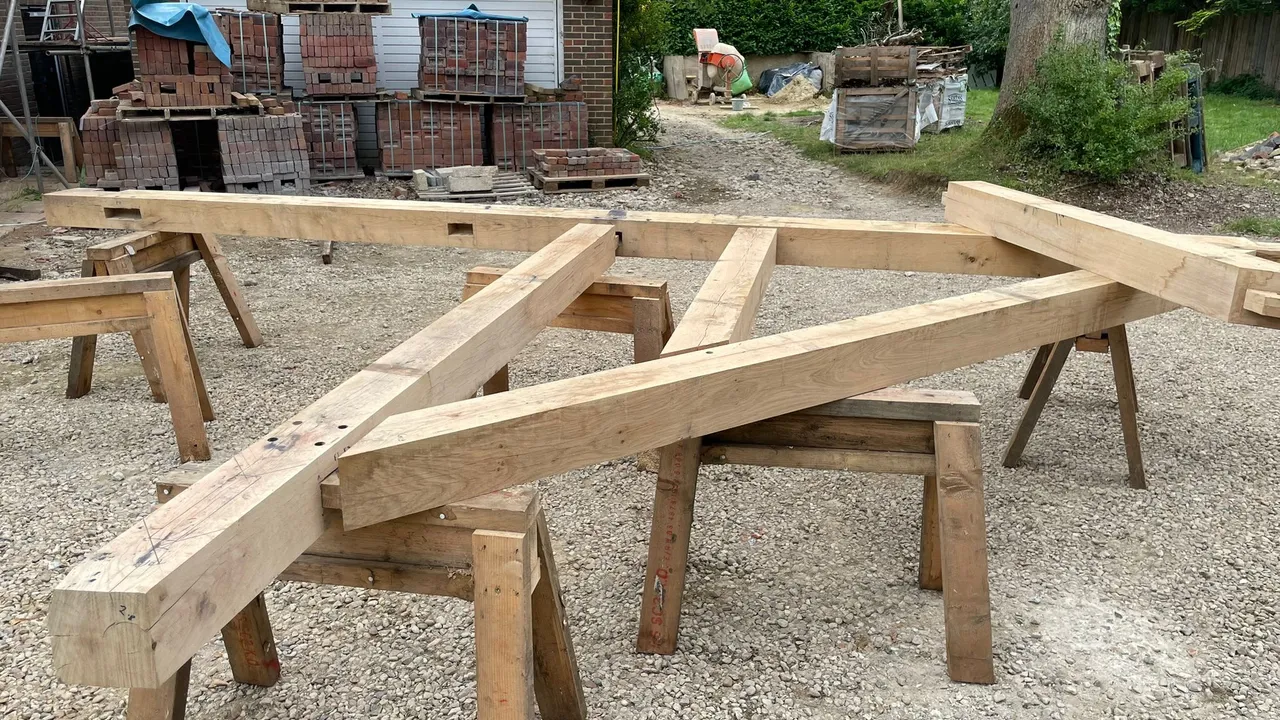
Green oak is oak that is cut and used before it has been dried. “Green” refers to the water still in the timber, not its colour: fresh-sawn oak is pale brown and very wet, and it dries out slowly over the years after it’s built into a frame.
As it dries it shrinks across the grain, opens splits along its length and can twist or bow a little. That movement is normal, and a properly built frame is designed around it.
I cut every frame from green oak, whether it’s an oak framed extension, a garage or a garden room. This post explains what green oak is, why framers use it, and what happens to it in the years after the frame goes up.
What green oak is
Green oak is European oak sawn from the log and used within months, without being air-dried or kiln-dried first. According to TRADA, the timber research body, it starts at a moisture content of 30 per cent or more, and often 80 to 100 per cent.
Those numbers look odd until you know how moisture is measured. It’s the weight of the water as a share of the weight of the dry wood. At 100 per cent, a beam is carrying its own dry weight again in water.
The same word gets used for any timber worked before it has seasoned. In practice, “green oak” in the UK means oak framing, and occasionally sweet chestnut, which behaves much the same.
Green oak, air-dried oak and kiln-dried oak
Oak is sold three ways, and they suit different jobs:
| Green oak | Air-dried oak | Kiln-dried oak | |
|---|---|---|---|
| How it’s dried | Not dried before use. It dries in the building | Stacked outdoors for years | Dried in a kiln over weeks |
| Sizes available | Large sections, 150 mm and up, several metres long | Planks up to about 100 mm thick | Thinner boards |
| Movement once fitted | Shrinks, checks and can twist as it dries | Much less | Very little indoors |
| Typical uses | Posts, beams, trusses and braces for frames | Cladding, joinery, smaller frame parts | Flooring, furniture, doors, worktops |
Sizes are from TRADA’s book Green oak in construction, which notes that air-dried oak is only available up to about 100 mm thick, while framing routinely needs 150 mm or more.
Why framers use green oak
Green oak is used for oak frames because it’s the only practical way to get oak in the sizes a frame needs. TRADA’s guidance notes that even modern kilns can’t economically dry the core of any section thicker than 100 mm, and air-drying a 200 mm post would take many years.
There are other reasons too, and they’re the ones that matter on site.
- It cuts cleanly. Wet oak is far softer to work than dry oak. Mortices, tenons and housings for the braces can be cut accurately with chisels and slicks, which is how a pegged frame is made.
- The joints tighten as it dries. A pegged mortice and tenon is drawn together by an oak peg driven through holes that are drilled slightly out of line, typically by about 3 mm according to TRADA. As the oak shrinks around the dry peg, the joint pulls tighter.
- It lasts without treatment. Oak heartwood is naturally durable, so a frame doesn’t need preservative as long as the sapwood is cut away.
- It gets stronger as it dries. A green oak frame is sized for the lower strength of wet timber, and the oak gains strength as it dries in the building.
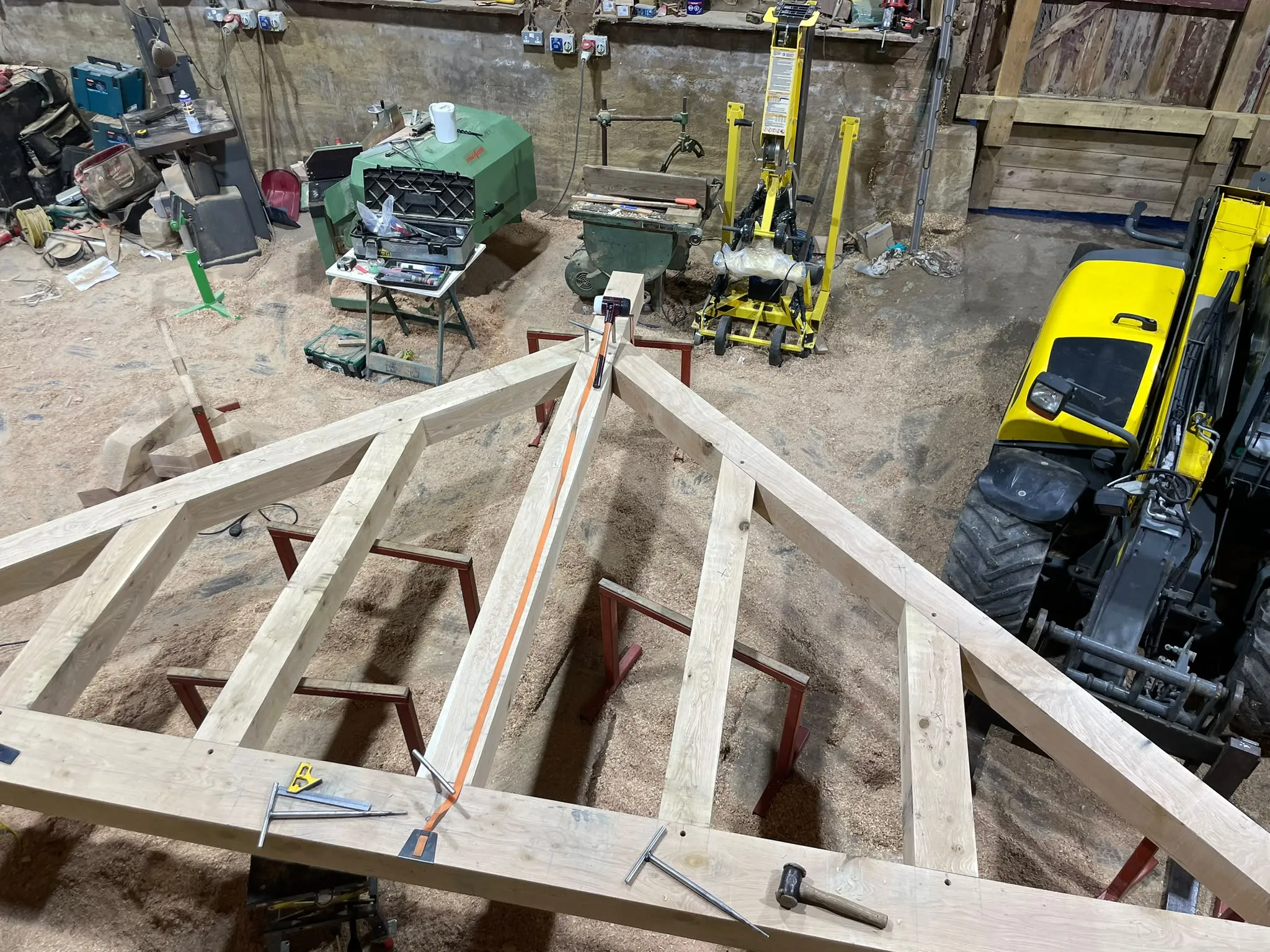
A green oak roof truss for the Cowfields kitchen extension, jointed and laid out in the workshop before it went to site. The holes along the bottom tie beam are for the pegs.
How green oak shrinks
Green oak shrinks across the grain as it dries, and hardly at all along it. Most of the shrinkage happens around the growth rings rather than across them, which is what opens splits in a beam.
The Wood Database gives English oak a shrinkage of 4.7 per cent across the rings (radial) and 8.4 per cent around them (tangential), going from green to completely dry. Along the grain, the USDA’s Wood Handbook puts shrinkage for most timbers at 0.1 to 0.2 per cent, which is too small to see.
Wood only starts shrinking once it drops below about 30 per cent moisture, and a frame never gets completely dry. If you take it down to around 12 per cent, the figure timber tables use for dry wood, the shrinkage is roughly 60 per cent of those totals.
In practice, that means:
| Measurement | Rough shrinkage drying to about 12% |
|---|---|
| A 200 mm post, across the rings | About 5 to 6 mm |
| A 200 mm post, around the rings | About 10 mm |
| A 3 metre post, along its length | A few millimetres at most |
These are rough figures, worked out from the published averages. A real post varies with how it was cut from the log, how fast it dries and the tree it came from.
The shrinkage isn’t instant. The outside of a beam dries first and the core follows over years, so a frame keeps settling for several years after it’s raised.
Checks and shakes: why green oak splits
As a green oak beam dries, splits open along its length. Framers call them checks or shakes. They’re the most noticeable thing about green oak, and the thing people worry about most.
They happen because the outside of the beam dries and shrinks while the core is still wet. The outside is held by the core, so it splits.
Shrinkage around the rings is nearly twice the shrinkage across them, so the split runs from near the heart of the tree towards the face. A post cut with the heart of the tree inside it is the most likely to check.
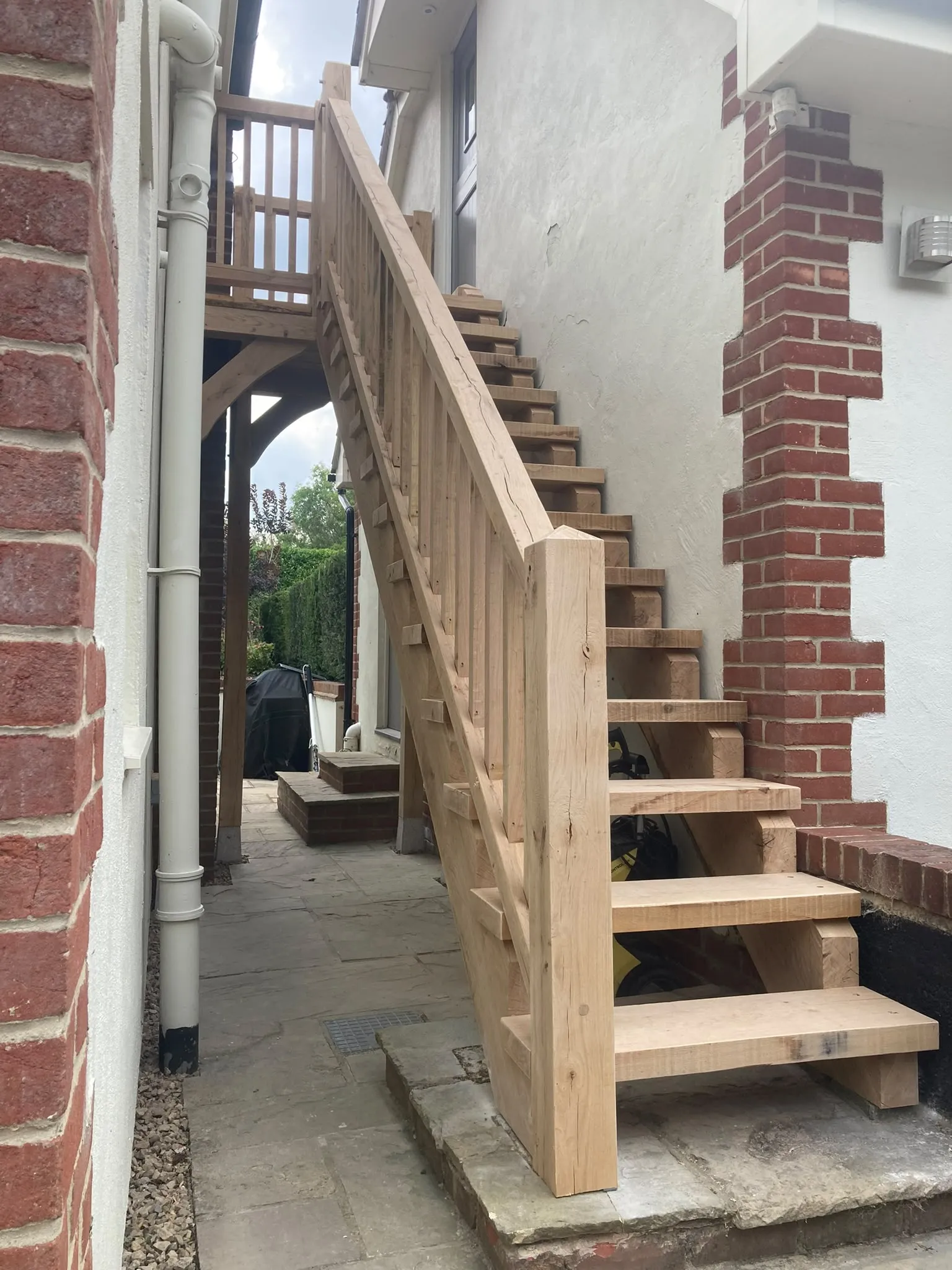
The external staircase I built for a customer’s garage. The fine lines running along the handrail and the newel post are checks opening as the oak dries.
TRADA says even large shakes are rarely a structural problem. A check is widest at the surface and tapers to almost nothing inside, so the beam keeps most of its section.
Two things make checks bigger:
- Heating. Inside a heated building, the outer faces of a large beam dry fast while the core stays wet. The first winter with the heating on is often when new checks appear.
- Sun. Outside timbers usually check less, but the faces that get the most sun check most.
On outside timbers, a wide check facing the weather can let rain in. TRADA notes these sometimes need sealing, which can be done without it showing.
How a green oak frame moves
Besides shrinking and checking, green oak can bow or twist along its length as it dries. Careful choice of timber reduces this, but nobody can predict exactly how each piece will behave.
In a frame held together with carpentry joints, the whole frame shrinks slightly as one, and the pegged joints pull tighter.
The movement matters most where the oak meets something that doesn’t move. Glass, plasterboard, dried joinery, brick and steel don’t shrink, so the oak shrinks away from them.
That’s why TRADA’s guidance says designers must allow for shrinkage in every part of the detailing. Where an oak post meets a wall panel, for example, a gap can open as the post shrinks and bows. The weatherproof joints there have to use seals that expand to fill the growing gap, rather than mastic that tears.
Glazing is the clearest case. A sealed glass unit can’t move with the frame, so anything glazed into green oak has to be detailed so the oak can shrink without cracking the glass or opening a gap round it. That’s worth asking about on any oak garden room or orangery.
What to expect in the first few years
A new green oak frame changes over its first few years, and knowing what to expect stops most worries before they start.
- Checks appear and widen, especially through the first heating season, then settle as the timber dries further in.
- Small gaps open where oak meets plaster, boarding or masonry, as the timber shrinks.
- Tannin runs off outside oak when it rains. The dark brown streaks wash out of the oak over time, but they can stain stone, render or a patio below. TRADA recommends protecting those surfaces while the oak is new.
- Iron stains it black. Oak’s tannins react with ordinary steel, so fixings into outside oak need to be stainless steel. A forgotten steel screw or a dropped nail leaves a black mark.
- Outside oak turns silver-grey in sunlight. Oils and clear finishes slow it down but don’t stop it; only a pigmented finish keeps the colour.
None of this is a defect. It’s what oak does, and it’s how the oak frames on old barns and houses look today.
Is green oak right for your building?
For a structural frame in oak, green oak is the usual choice. The large sections a frame needs only come green, and pegged joints pull tighter as it dries.
Where the oak is thin, or needs to stay still, dried oak is better. That covers doors, flooring, worktops and some cladding.
If you’re planning an oak building and want to know how the frame will behave in your house, or you’ve got an oak frame that’s checking and want a second opinion, get in touch. There are photos of frames I’ve cut and raised in the gallery.